
Core Design Team
Firm: Driftmier Architects
Lee Driftmier – PRINCIPAL ARCHITECT
Michael Winnick – PRINCIPAL ARCHITECT
Consultants/Collaborators
Well Design: RH2 Engineering
General Contractor: Grenlar Construction
Civil: Contour Engineering
Structural: Armour Unsderfer Engineering
Mech/Elect/Plumbing: Rensch Engineering
Geotechnical: GeoResources
Cost Estimating: The Woolsey Company
Project Narrative
WHERE PAST AND PURPOSE MEET
The restoration of the Arletta Schoolhouse stands as a thoughtful convergence of past and present—a project rooted in preservation, accessibility, and community pride. Every design move was made with care: honoring the historic character, enhancing environmental performance, and creating a welcoming, flexible space that continues to serve as a civic heart for Gig Harbor. This revitalized landmark now carries its legacy forward, ready to inspire the next generation of gatherings, celebrations, and shared experiences.
BUILDING INSPIRATION
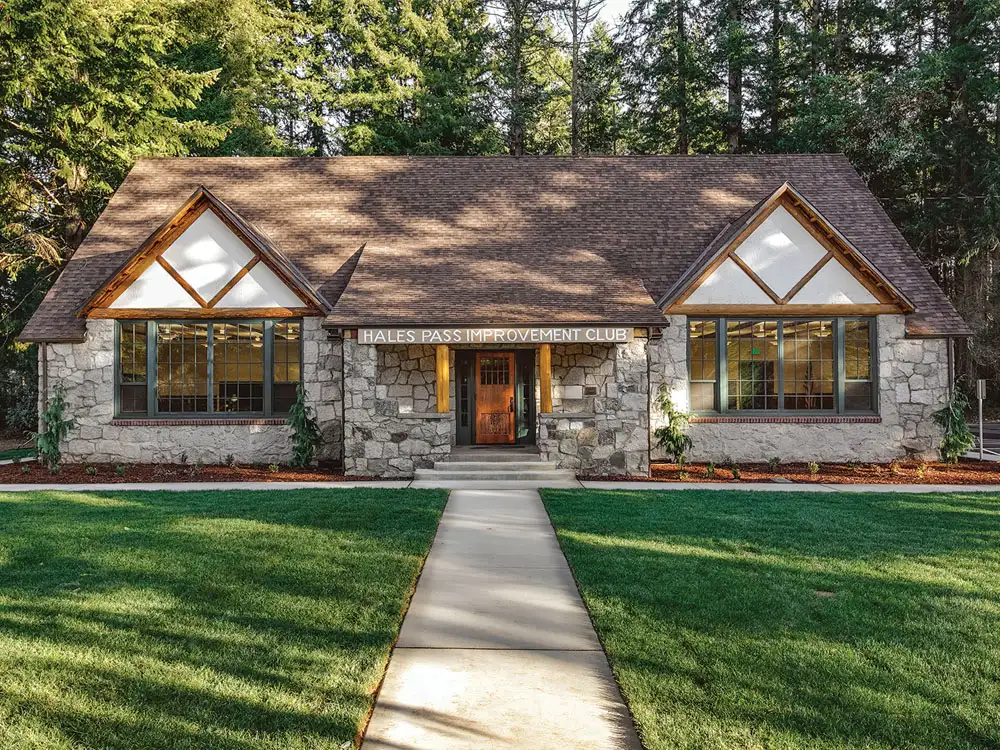
Tucked within the lush four-acre expanse of Hales Pass Park in Gig Harbor, Washington, the Arletta Schoolhouse has long stood as a community anchor. Originally constructed in 1938 under the Works Progress Administration, this two-room stone structure exemplifies the Rustic architectural style characteristic of New Deal-era public works, defined by local materials, hand-crafted detail, and a quiet humility that lets the surrounding landscape take center stage. The 2022 restoration and modernization of this historic building reimagined it for contemporary use while honoring its original spirit and ensuring its continued role as a civic gathering place.
The kitchen and restrooms were reconfigured and rebuilt to support modern events, all while maintaining a minimalist intervention approach. The result is a space that feels updated but not altered, where guests walking through the front door experience the same warm light through the multi-paned windows that generations of students once did. The iconic steep roofs are inspired by styles of Norwegian builders, used to shed heavy snow loads. The project also addressed and enhanced outdoor amenities, including lighting and power for the adjacent covered pavilion, seamlessly tying the interior experience to the surrounding natural environment.
BUILDING INTEGRATION
Rather than distinguish itself, the Schoolhouse was designed to reflect and blend with its environment, a principle that the restoration team held fast to. Original construction materials, sourced directly from the site in the 1930s, were left exposed and honored. All new exterior work, from the parking lot to the event shelter re-roofing, used tones and textures that harmonize with the wooded park setting. The building’s modest scale and warm material palette make it feel like a natural extension of the land. The project improved the civic accessibility of the site through newly paved drives, ADA-compliant parking, and an accessible route from car to south side entrance—all executed with minimal disruption to the existing park layout. The restored building now functions as a vital link in the community: flexible enough to host private events, public meetings, and recreation programs for all ages, while continuing to serve as a reminder of Gig Harbor’s past.
ENVIRONMENTAL SENSITIVITY
Preservation is inherently sustainable. The approach to this project prioritized reuse over replacement wherever feasible. Every piece of salvageable wood was repaired and refinished. The original structure—with its thick masonry walls, natural ventilation pathways, and simple footprint—lends itself well to low-energy use. However, modern updates to the HVAC, plumbing, and electrical systems were also installed to improve energy efficiency and ensure the building meets current standards without compromising its historic character. A new well was added to provide a sustainable water source for the facility, and outdoor lighting was thoughtfully placed and shielded to limit light pollution and preserve the rural, park-like feel of the setting. Additionally, a new storm-water infiltration system was installed to help control runoff.
SOCIAL IMPACT
The Arletta Schoolhouse is more than a building—it is a place with a collective memory. Closed as a school in 1959, it has since served generations as a venue for everything from holiday celebrations to public meetings and weddings. Its restoration reaffirms the community’s values around heritage, access, and togetherness.
Human-scaled, walkable, and located in a park equipped with sports courts, a picnic area, and forest trails, the Schoolhouse is easily accessible to residents on foot, bike, or car. Its simple, approachable design and visible commitment to inclusion: ADA entrances, restrooms, and parking, make it an equitable and welcoming space for all users. The flexible floor-plan allows for a variety of activities without expensive or intrusive modifications, increasing the range of events it can support.
CLIENT SATISFACTION
From day one, the client articulated a clear goal: modernize the Arletta Schoolhouse while preserving its character, function, and place in the hearts of community members. This goal became the north star for the project team. Throughout the process, collaboration was key. During early phases, the team worked closely with stakeholders to assess deficiencies, prioritize upgrades, and create a solution set that aligned with the community’s values and the park’s operational needs.
Communication remained strong through permitting, bidding, and construction administration, allowing the project to stay on schedule and within the $1 million budget. With a final bid of $998,000, the project reflects a disciplined and responsive design process. The result is a facility that not only meets current code and accessibility standards but also feels vibrant, welcoming, and faithful to its roots. In the words of the Executive Director of the Parks District, “We’re replacing things that are at or near the end of their useful lives, all while maintaining the character of the historic building.” That sentiment has been echoed by staff, neighbors, and park-goers alike, who now use the Schoolhouse with pride and renewed enthusiasm.
Arletta Schoolhouse, Gig Harbor, WA
Honorable Mention for Community Impact
2025 AIA/WA Civic Design Awards
Client: PenMet Parks
Firm: Driftmier Architects
Photos: Erik Sven Photography
Gallery


- Driftmier Architects