
Core Design Team
Firm: TCF Architecture
Randy Cook
Scott Olson
James Choate-Deeds
Gail Merth
Coreen Van Ausdell
Ryan Cornwall
Jeremy Smith
Pam Humphreys
Teta Brown
Brie Braukmann
Mishka Morgus
Consultants/Collaborators
GC/CM: Absher Construction
GC/CM Advisor: Parametrix
Geotechnical Engineer: Budinger & Associates
Civil Engineer: RH2 Engineering
Landscape Architect: Berger Partnership
Equipment Consultant: Pinnacle Consulting Group
Food Service: Clevenger Associates
Structural Engineer: PCS Structural Solutions
MEP & Fire Protection Design: Interface Engineering
Acoustics: BRC Acoustics (now Coffman Engineers)
Exterior Envelope: Allana Buick & Bers
Furnishings: Perrault, Inc. & One Work Place
Hardware: Adams Consulting & Estimating
Paint & Coatings: TM Coatings
Elevator: Lerch Bates
Signage and Graphics: Jinger Hendricks Graphic Design
Cost Control: RC Cost Group
Project Narrative
INTRODUCTION
Chelan County Public Utility District (PUD) owns and maintains three dams located along the Columbia River and lower end of Lake Chelan. In addition to supplying hydroelectric power to customers of Chelan County (and beyond), the PUD offers amenities such as parks, trails, boat launches, and the Rocky Reach Discovery Center. These shared assets underscore the PUD’s commitment to enriching community life through access to nature, history, and hydro-powered public resources.
Across eight decades, its maintenance, operations, and administrative facilities were spread out over three sites in a dozen aging buildings. They were in poor condition, inefficient, and costly to maintain.
In 2015, the PUD reached a critical decision point: continue with the status quo, renovate existing facilities at present sites, or pursue an entirely new approach. Across three years, their design team led a comprehensive exploratory process of qualitative and quantitative evaluation, driven by a 50-year comparative analysis of the three scenarios. Findings formed a strong business case that enabled leadership to confidently commit to constructing a new, consolidated Service Center campus.
INSPIRATION
The PUD’s mantra, “Owned By The Customers We Serve,” drove development of a campus representative of the rich history of the organization and culture of the county. Conveying the region’s unique characteristics through the architecture was of utmost importance to the PUD, whose shared values of Safety, Stewardship, Trustworthiness, and Operational Excellence guided early efforts, generating the phrase “Presence and Prominence, without Pretense.”
The site for the new Service Center, positioned at the convergence of the Columbia and Wenatchee Rivers, offered sufficient acreage for the diverse and expansive program. Furthermore, the location would enable the PUD to prominently anchor itself in a location that would enhance the deployment of operations while offering convenient access by customers and visitors.
In recognizing how the new campus would sit at the confluence of rivers, roads, and the future of the PUD, a unifying theme of ‘Confluence’ emerged. This idea went beyond geography, bridging short- and long-term goals; legacy and emerging technologies; and senior and next-generation employees—establishing the intersection of a new era of resilience and collective prosperity.
INTERACTION
The design team organized and conducted employee engagement workshops over many months, diving deep with staff representing over 40 different PUD departments. In addition to surveys offered to all personnel, 100+ interacted face-to-face with the design team through hours of discussions and white board diagramming, all in search of optimum workflow and space sizing, efficient adjacencies, and other design criteria that would remove impeding barriers to create a next-generation workplace where everyone flourishes.
INTEGRATION
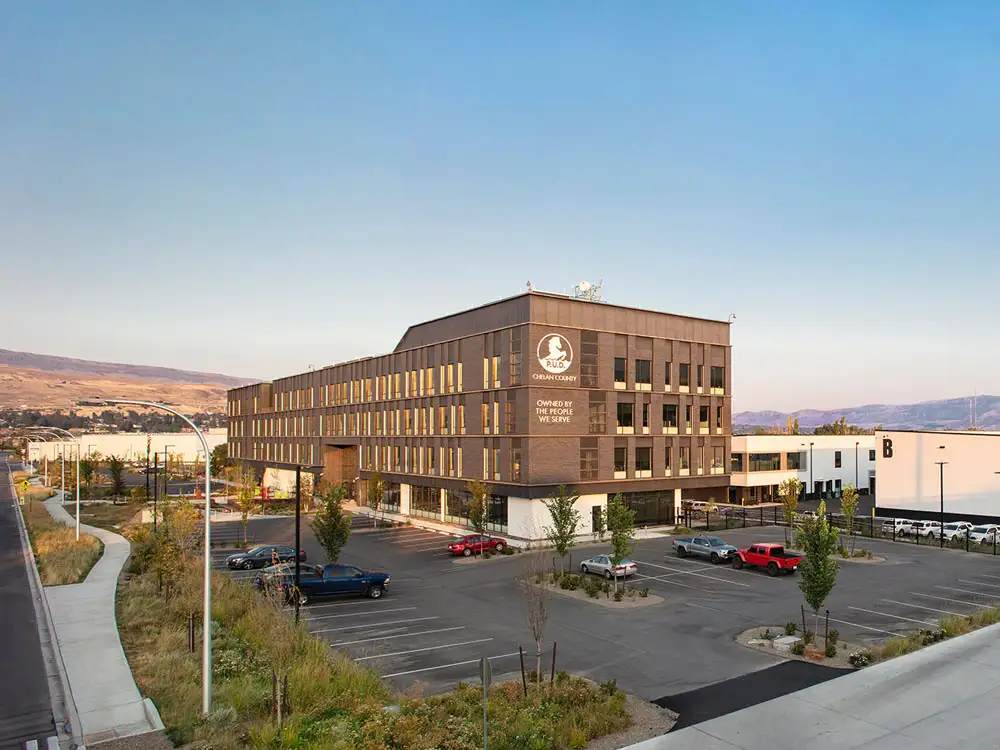
The layout of the campus capitalizes on the oddly-shaped site and the gently sloping topography as the south parcel drops off toward the river at its southern boundary. (A separate parcel across Olds Station Road supports about 75% of total staff parking.) When arriving from the north as a driver or pedestrian, the axial view from the street aligns with the double-height, glazed wall of the administration building’s main lobby. This feature is mirrored at the opposite side, affording customer-owners an opportunity to view the inner workings of the PUD’s operations yard beyond.
Within the yard, a series of buildings, including warehouses, shops, storage facilities, vehicle maintenance bays, and a fuel and wash station, are arranged to form a network of streets and alleys. This layout ensures safe and flexible circulation for vehicles and pedestrians and drives operational efficiency campus-wide.
The project was completed in 2024 for $105 million.
ENVIRONMENT
Like the dams that generate clean, renewable power, PUD leadership embodies an attitude of environmental stewardship and energy conservation, always aiming to demonstrate wise use of rate payer resources. Producing new facilities of high, long-term value with desirable environmental benefits required the integration of myriad operational and programmatic criteria by the design team, who further navigated changing regulatory requirements, industry standards and best practices, and met budgetary thresholds. Collaboration and cooperation between architect, owner, and GC/CM produced a comprehensive design that protects and supports the PUD’s assets while creating a highly desirable work environment that promotes human health, safety, security, collaboration, professionalism, and delight.
The benchmark goal for energy conservation: meet the AIA 2030 Challenge for the 2015 design year, which meant striving to achieve a 70% energy reduction from the 2004 CBECS baseline. Sustainable and energy efficient solutions are shaped by:
Location and Longevity:
The first bold move was the decision to co-locate all operations, administrative, and customer service functions to a single campus. This would optimally position field crews for efficient deployment to service areas, while improving customer access to services.
Building Orientation and Volume:
The site geometry and relationship to the main street offered an ideal opportunity to configure the campus for efficient operations and to employ east-west orientation to minimize energy consumption. The simplified, slender form of the administration building minimizes exterior wall surface and optimizes daylighting. Understanding that in Wenatchee’s climate, heating load demands in this building will draw substantially more energy throughout the year than cooling loads, the long south and north faces work in concert with the selected HVAC systems.
Energy Demand Reduction:
The design team focused on strategies to further reduce energy demand on the HVAC, domestic hot water, and electrical systems through improved envelope performance including high performance glazing/window systems, window shading, optimized daylighting, passive solar systems, insulation systems (particularly continuous exterior insulation with an air space behind the cladding), thermal mass, high efficiency lighting & controls, and low flow plumbing fixtures. Recognizing that 38% of the energy use of the building serves heating loads (12% serving cooling), heating energy strategies leverage three times the benefit of cooling strategies for the Wenatchee climate.
Heat Capture and Transfer:
Reduced electrical demand is coupled with HVAC systems that optimize natural resources such as passive solar heat, and energy transfer within the building throughout Wenatchee’s diverse, seasonal weather conditions and long solar days.
Results:
Multiple systems and features work together for energy efficiency and best value life cycle costs. The administration building is designed to achieve a 65% reduction in energy consumption over baseline, more than 40% more efficient than a building designed to code minimum standards in the same location. The campus overall is designed to achieve a blended EUI of 29 and operate at a blended 20% efficiency improvement considering all shops and storage buildings.
Chelan County PUD Service Center, Chelen, WA
Citation Award
2025 AIA/WA Civic Design Awards
Client: Chelan County PUD
Firm: TCF Architecture
Photos: Peter Eckert, Eckert and Eckert Architectural Photography
Gallery


- TCF Architecture