
Core Design Team
Firm: 7 Directions Architects/Planners
Daniel Glenn, AIA, AICAE – Principal-in-Charge
Laila Montenegro – Project Manager
Esteban Vallejo – Project Architect
Bobbie Koch – Project Designer
Consultants/Collaborators
Landscape Architect: The West Studio
Civil Engineer: Northwest Civil Solutions
Structural Engineer: Lund Opsahl
MEP Engineer: TresWest Engineers
Project Narrative
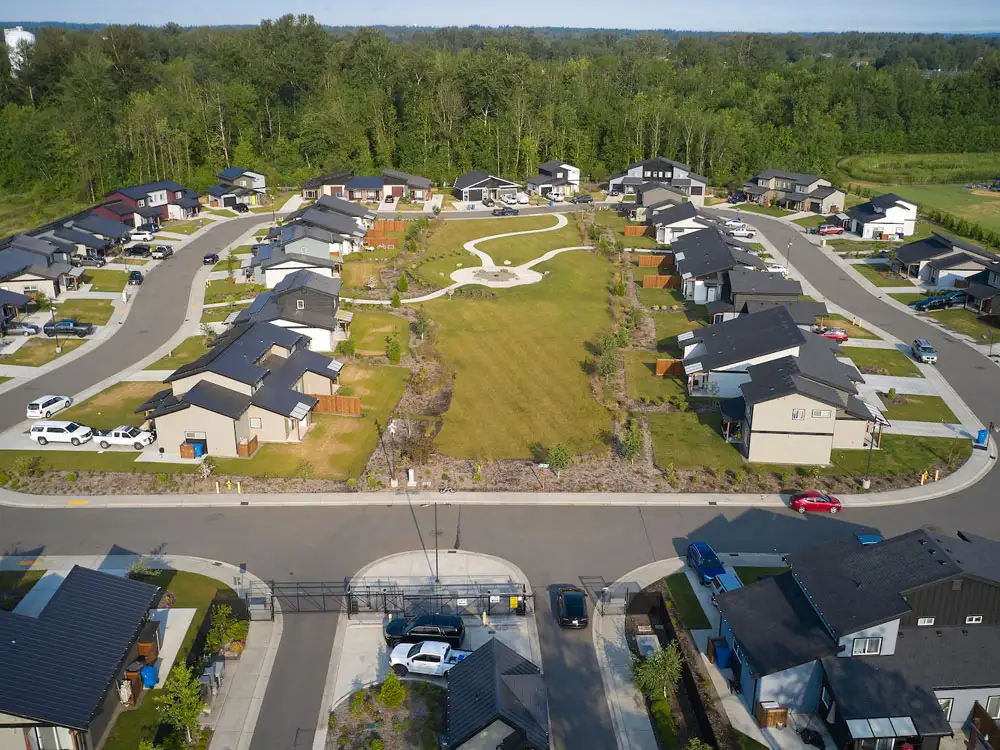
Muckleshoot Indian Tribe’s Mount Rainier View Village: In 2023, the Muckleshoot Indian Tribe proudly completed construction of Mount Rainier View, the Tribe’s newest affordable housing community. This milestone development was initiated in 2021 and completed in two phases, resulting in 58 high-quality rental homes. The project was made possible through a strategic blend of Tribal investment and federal funding:
- Indian Housing Block Grant – two competitive awards; $10,000,000
- Indian Housing Block Grant: $2,700,000
- Muckleshoot Indian Tribe: $2,200,000
- Indian Housing Block Grant – American Recovery Plan: $1,115,000
Need for the Project
The Muckleshoot Indian Reservation faces a persistent shortage of affordable housing for Tribal members. Mount Rainier View was developed in direct response to a multi-year waiting list and the urgent need to increase local housing options. Located on the Reservation, the project ensures residents have access to employment, cultural activities, and essential supportive services – promoting long-term housing stability and Tribal community connection.
This new development also marks a significant milestone in the Tribe’s commitment to healthy housing. Mount Rainier View is the Muckleshoot Tribe’s first clean and sober rental community, dedicated to fostering wellness and recovery in a supportive housing environment. Additionally, the project incorporates Zero Energy Ready Homes (ZERH) and Net Zero homes, setting a new standard in residential construction for the Tribe. These advanced homes deliver:
- Outstanding energy efficiency and cost savings
- Improved indoor air quality and thermal comfort
- Environmental sustainability and reduced carbon footprint
- Durable, high-performance construction
By integrating clean and sustainable building practices, the Muckleshoot Indian Tribe created more than affordable housing – a healthier, more resilient community that honors both people and the planet.
Context and Site
The site selected by the Tribe is in the heart of the Muckleshoot Tribe’s Reservation south of Auburn, Washington, within the watershed and viewshed of Mount Rainier. Known as Mt. Tahoma to the Salish people of the region, it is considered a sacred mountain and a source of life for the region. The Muckleshoot Reservation is home to the Duwamish people, as described on the tribe’s website:
The Duwamish peoples were displaced from their villages along the Duwamish, White, Black, Green, and Cedar Rivers, Lake Washington, and the Seattle waterfront when settlers arrived in the area and pushed them out through oppression, land acquisitions, and treaties. In 1857, a small portion of land was set aside for Native peoples on a prairie in South King County that was called “Muckleshoot,” an anglicized version of the Lushootseed word, “bəqəlšuɫ.” This small portion of land would later become the Muckleshoot Reservation where many Duwamish ancestors moved to over time.
By the 1870s, Native peoples associated with the Muckleshoot Reservation started being referred to as “Muckleshoot” by the federal Indian agents — named for the upland prairie they now call home rather than the historic names of their Duwamish, St’Kamish, Green River, Upper White River, and Upper Puyallup villages. Though known as Muckleshoot, the Tribe retains the treaty rights to hunt, fish, and gather throughout the region its Duwamish and Upper Puyallup ancestors inhabited for thousands of years.
The site is adjacent to the Muckleshoot Recovery House and the Muckleshoot Behavioral Health offices, in walking distance to the Muckleshoot Elder’s Center and the Muckleshoot Wellness Center; an ideal location for a village focused on health and wellness for its residents. The site was an undeveloped farmland with a large wetland on the west side.
Muckleshoot Culture and Community
Traditionally, the Muckleshoot lived in villages of plank houses, which were multi-family, multi-generational structures in clustered communities built along waterways. These villages were systematically destroyed during the colonization process. The design seeks to create a contemporary multi-generational village environment.
Culturally responsive design was paramount to foster a healthy community connected to nature and surrounding tribal resources. In addition, it was a priority that the community be a safe and secure setting for multi-generational residents, including elders and families with children.
Design Process
This project was designed largely during the period of COVID-19 restrictions, so the Design Team was limited in opportunities for direct engagement with potential residents. The design process consisted primarily of meetings with housing staff and developing multiple options for both the site and housing types. Four options were explored and presented to the staff. The options included:
- Option 1: Divide the site into two central blocks with a loop road and a central boulevard with row housing.
- Option 2: Duplex housing placed along a single loop road with a central shared common area and a single entrance.
- Option 3: Four smaller clusters of duplex housing branched from a central main roadway.
- Option 4: 6-plex rowhouses based on the longhouse arrayed in a grid on the site.
The staff preferred the second option, a central common space with a single loop road. This site plan it provides both a strong sense of community with the central common space. It was seen as the most secure with a single entranceway.
The homes were arrayed along an east/west axis to maximize solar gain for photovoltaic panels on south-facing roofs.
The common area at the center of the community is intended to provide space for community gatherings, play areas, gardening, and walking paths. The walking paths connect through the common area to the community facilities north of the site. At the center of the common area is a fire pit, a place of gathering and ceremony.
Housing Designs
In order to maximize the number of units on the site and to meet the required unit mix, the Design Team developed four building types: fourplex, triplex, duplex, and single-family houses (for larger families). The house plans were designed to emulate the layout of the traditional cedar plank house, with a central common space (combined living/kitchen/dining) in the center of the homes and the bedrooms on either side of this space or on the second floor. The central common areas open out to large front porches facing the public street. Rear private deck areas face either the surrounding wooded edges of the site or the central common area.
The roofs are a variation of the cedar plank house gable roof. The gable is stepped to offset the roof for more area for PV panels. The homes were modeled during the design process to determine the necessary roof area to achieve Energy Net Zero homes.
Materials
Selected building materials were based on affordability, durability, fire-resistance, and cultural responsiveness. Siding for the homes is wide horizontal cement board siding, intended to emulate the large cedar planks of the traditional plank house in a contemporary and fire-resistant material. Porches incorporate heavy timber construction to reflect the traditional heavy timber plank house framing. The siding is applied as a rain screen to maximize long-term durability and avoid mold. The roofs in Phase Two are all metal for durability and cleaner runoff, included due to different grant funding that allowed greater investment in sustainable features.
Building Sustainability
All of the homes were designed to be solar-ready with the possibility of being Energy Net Zero once panels are installed. Only the Phase Two houses currently include the PV panels due to funding limitations on Phase One, but they can eventually be added. In order to achieve Net Zero, the homes include super insulation (R-30 walls and R-60 roofs), energy-efficient appliances, and heat pump heating/cooling and water heaters. All of the homes were modeled during the design process to ensure that they could achieve the Net Zero standard.
Site Sustainability
Sustainable Landscape Strategies for the Mt. Rainier View Village include:
- Protection of the existing wetland on the site through careful layout of the roads and homes.
- Incorporated Pacific Northwest native and climate-adapted plant species that require less water, fertilizer, and pest control, and support biodiversity, cultural appropriateness, and foraging opportunities.
- Native species support local pollinators and wildlife, creating a resilient ecosystem.
- Selected low-maintenance plantings to align with long-term maintenance requirements specified by the client.
- The outer meadow was designed to preserve the original site character with a low-input meadow using grasses and wildflowers, restoring habitat and reducing overall irrigation and maintenance needs. The meadow will include camas to be harvested by residents.
- The use of deciduous trees provides shade during the summer and winter sunlight.
Muckleshoot Indian Tribe Mount Rainier View Village, Auburn, WA
Honorable Mention for Integrating Indigenous Values
2025 AIA/WA Civic Design Awards
Client: Muckleshoot Indian Tribe – Muckleshoot Housing Authority
Firm: 7 Directions Architects/Planners
Photos: Doug Walker Photography
Gallery


- 7 Directions Architects/Planners