
Core Design Team
Firm: Miller Hull Partnership, LLP
Ron Rochon, FAIA
Sian Roberts, FAIA
Ruth Baleiko, FAIA
Nick Clesi, AIA
Cristine Traber, AIA
Mat Albores, AIA
Japneet Pahwa
Alex Dallas
Claire Fontaine
Tahmina Arjona, NCIDQ
Jennifer Stormont, AIA
Tania Martinez
Steve Doubs, AIA
Marjorie Anderson
Chris Hellstern, AIA, LFA
Chris Grammens, AIA
Wojtek Szczerba
Rio Namiki, AIA
Alex Wolfrum, AIA
Olivia Backer, AIA
Consultants/Collaborators
Contractor: Hoffman Construction Company
Structural Engineer: Lund Opsahl
Civil Engineer: Reid Middleton
MEP Engineer: PAE Consulting Engineers
Landscape Architect: Murase Associates
Envelope Consultant: 4EA Building Science
Security Consultant: Hohbach-Lewin
Lighting Designer: Dark | Light
Signage: Mayer/Reed
Vertical Transportation Consultant: The Greenbusch Group
Transportation Consultant: Heffron Transportation
Acoustical Consultant: BRC Acoustics
Building Code Consultant: Pielow Consulting
Cost Consultant: JMB Consulting Group
Historic Preservation: BuildingWork
Project Narrative
HONORING
CAPITAL CAMPUS CHARACTER
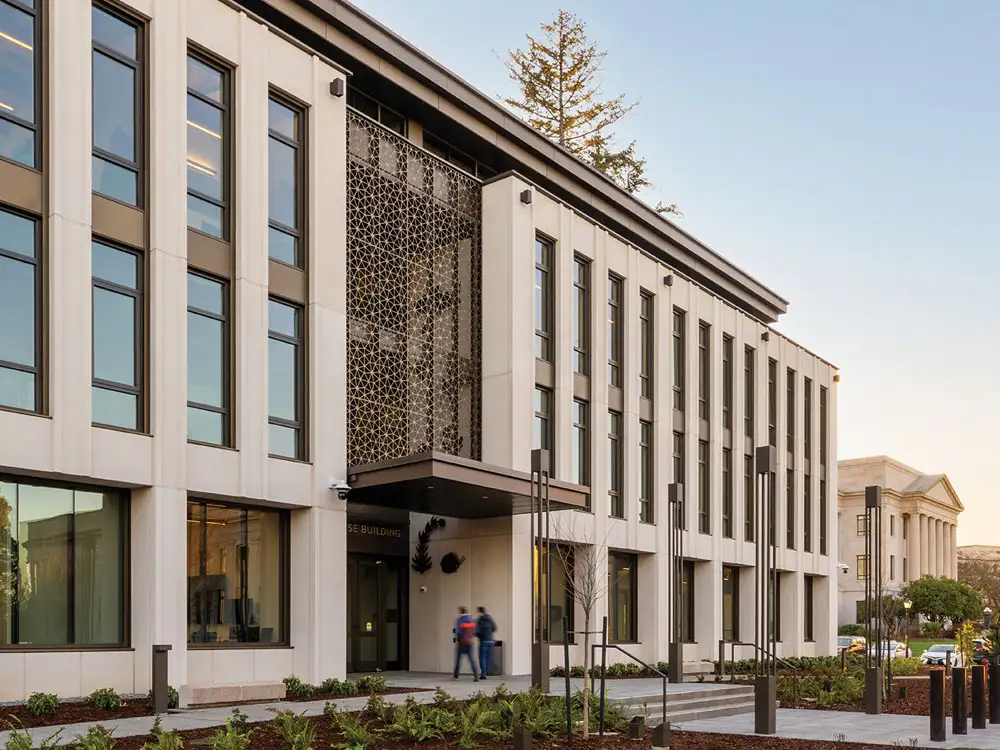
The Newhouse Replacement Building redefines the intersection of history and progress on Washington State’s Capitol Campus, creating a civic workplace where past meets present, legislators meets citizenry, and place meets policy. Designed as part of the Legislative Campus Modernization (LMC) initiative, the new structure honors the campus’s architectural legacy and historic significance while integrating contemporary sustainability, ecological stewardship, and functional efficiency to serve the state for generations.
DECONSTRUCTION & REUSE
While the original Newhouse Building no longer stands, its legacy endures through thoughtfully salvaged materials. Marble, sandstone, and textured glass panels from the 1934 structure have been salvaged and repurposed in the new building, preserving a tangible connection to the past within a contemporary civic space. Together, these thoughtful strategies have reduced the embodied carbon footprint by approximately 18 tonnes of carbon dioxide equivalent (tC)2e) while honoring historic elements from the Capitol Campus.
Salvaged timber from the 1920s and ’30s Carlyon and Ayer Press Houses–once home to the Capitol Press Corps–also finds new life in the Newhouse Building. Through relocation of these historic structures was deemed infeasible, the structures were carefully deconstructed, and their materials have been meticulously reintegrated, ensuring their stories remain part of the Capitol Campus’s evolving narrative.
REGIONAL CONTEXT
At the heart of the building lies the four-story feature stair, illuminated by a skylight that brings light into the space. This central hub, known as the “Mixing Chamber,” fosters collaboration and interaction among staff and legislators, transforming the space into a vibrant hub of shared stories. The mixing chamber highlights a four-story art wall made from reclaimed Douglas fir timber from the Press Houses. The installation honors the breadth of diversity of Washington’s landscapes and constituents represented by the work in this building.
INNOVATING
GOVERNMENT OF TOMORROW
In response to today’s hybrid work realities, the Newhouse Building incorporates flexible spaces that support both in-person and remote collaboration, ensuring legislative work remains resilient and responsive. On the first floor, the design team prioritized a welcoming community space featuring the Senate Meeting Room and the Legislative Page School. Expansive windows and an open floor plan create a sense of connection and transparency, inviting the public to participate in democracy.
Beyond the building itself, the site design embraces the Capitol Campus’s role as a public park–originally master planned by the Olmsted brothers–welcoming visitors year-round with landscaped public plazas and new pedestrian pathways to provide connections to the greater campus.
MATERIAL SOURCING
As the newest building on the State of Washington’s Capitol Campus, it is an expression of the legislature’s most current and pressing priorities, addressing climate, human health and local economies through the careful selection of materials. The design team prioritized local vendors, trades, and materials without chemicals of concern, ensuring state funds were directed towards both Washington’s economy and its environmental priorities.
This decision extended to the casework and furniture package where, for example, the choice was made to eliminate all plastic laminate and instead use natural wood veneers and marmoleum.
ENDURING
INVESTMENT IN THE FUTURE
The Newhouse Replacement Building represents the first new building on the Historic West Capitol Campus since 1958. To ensure this investment provides value well into the future, the plan parti and systems routing were carefully designed to maximize adaptability for future programmatic needs.
Provisions have been made within the building to connect to a future decarbonized campus central utility plant. Additional infrastructure and capacity have been built-in so that future PV panels can be added on site over the parking area to offset operational energy needs. Together, these features ensure that the building is prepared to meet the needs of today while paving the way for a more sustainable tomorrow.
SUSTAINABLE LEGACY
Newhouse serves as a beacon of sustainable design, showcasing the state’s commitment to reducing carbon emissions as exemplified by Executive Order 20-01. Recently achieving LEED Platinum, it is net-zero ready with a 90-kilowatt roof-mounted photovoltaic array, which accounts for 22% of the building’s energy demand. Rather than connect to the campus central steam plant, the building relies on all-electric heat pumps for heating and cooling. The all-electric design and building envelope are exceptionally efficient, with an estimated energy use intensity (EUI) of just 19, representing more than a 75% reduction compared to the baseline.
“The Newhouse project demonstrates how a public building can be both rooted in tradition and responsive to the future. The design team maintained a deep respect for the legacy of the Capitol Campus while delivering a space that supports transparency, sustainability, and collaboration for years to come. The process felt truly collaborative—we always felt heard, and the final product reflects that shared commitment”.
Newhouse Building Replacement, Olympia, WA
Honor Award
2025 AIA/WA Civic Design Awards
Client: Department of Enterprise Services (DES)
Firm: Miller Hull Partnership, LLP
Photos: Marissa Lordahl, Hoffman Construction
Gallery


- Miller Hull Partnership