
Core Design Team
Firm: Perkins&Will
Anthony Gianopoulos: Principal In-Charge
Ryan Bussard: Lead Designer
Andrew Clinch: Project Manager
Susan Clark: Lab Planner
Tony DeEulio: Senior Project Architect
Shanni Hanein: Project Team Lead
Melanie Baron: Designer
Alycia Schramm: Interior Designer
Devin Kleiner: Sustainability Lead
Jesce Waltz: Carbon Expert
Jason McLennan: Living Building Challenge Expert
Joanna Jenkins: Living Building Challenge Expert
Consultants/Collaborators
Mechanical and Plumbing: Affiliated Engineers, Inc.
Electrical: Hargis
Structural: Coughlin Porter Lundeen
Civil: KPFF
Landscape: Berger Partnership
Lighting: Blanca Lighting Design
Envelope: Morrison Hershfield
Acoustics/AV/Elevator: Greenbusch
General Contractor: Mortenson
Electrical Contractor: VECA
Project Narrative
SETTING THE PACE
With growing STEM enrollment and increased industry demand in Washington State, Western Washington University (WWU) recognized the need for a new multidisciplinary facility to keep pace and expand opportunities in science, technology and engineering education. Kaiser Borsari Hall is a high-tech 53,300-square-foot learning environment that sets the standard for future campus projects, as the first all-mass timber, net-zero energy, and zero-carbon engineering lab building. It is a collaborative hub fostering innovation and connection among industry experts, faculty, and students, promoting diversity and inclusion within the campus community.
THE FUTURE IS NOW
In 2017, WWU adopted its Sustainability Action Plan, setting an ambitious goal of achieving carbon neutrality by 2035, and in 2021, it became a founding adopter of the Okanagan Charter, which calls on higher education institutions to integrate health and well-being into all aspects of campus culture. These commitments, which are helping reach the University’s carbon neutrality goal, combined with the university’s strategic focus on sustainability and inclusion, resulted in the first higher education STEM building to pursue both Zero Carbon and Zero Energy Certifications through the International Living Future Institute, setting a new standard for sustainable construction on WWU’s campus. As the first fully electrified building on campus, Kaiser Borsari Hall has detached from the steam plant, significantly advancing Western’s vision to become the State’s first carbon net-neutral university campus showcasing WWU’s leadership in environmental stewardship and innovative campus development.
DESIGN AND WELLNESS
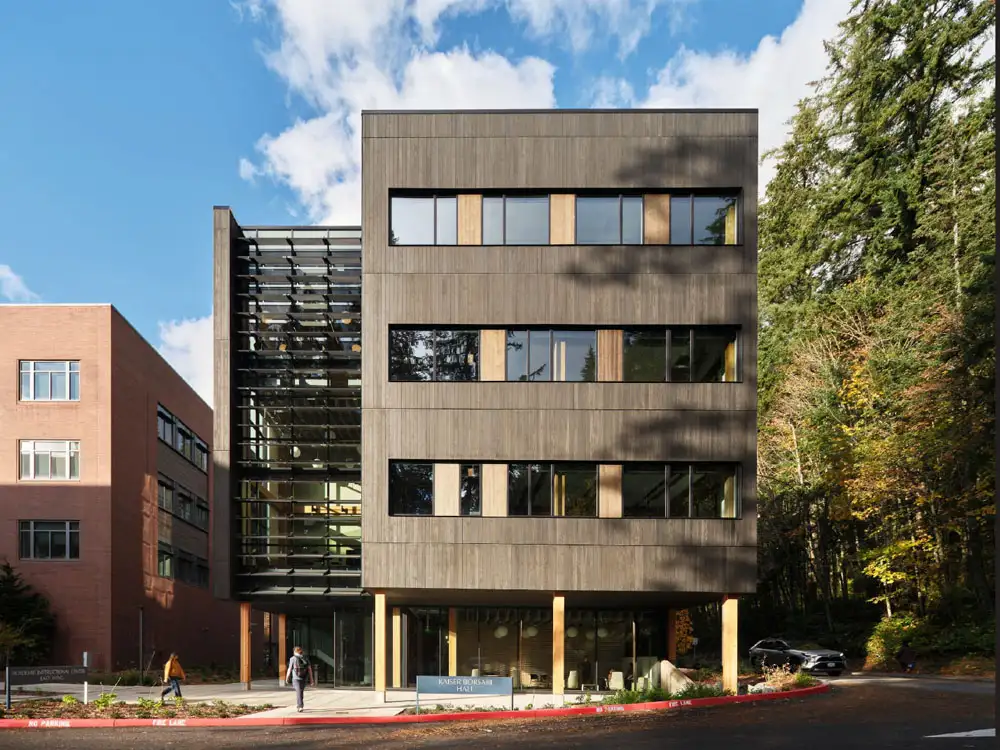
Conceived as a simple yet elegant mass timber structure, the building is slipped into a narrow site where proportion and height are optimized for the mass timber structural system. The design plays on contrasting wood finishes where the exposed wood—both inside and out—adds natural beauty and creates a warm and inviting environment to what was formerly a parking lot.
Inspired by biophilic design principles, the building incorporates shou sugi ban wood siding on the exterior to contrast the exposed warm tones of the mass timber structure inside. This simple charred box sits atop a glass and concrete base creating a strong visual and direct connection to the campus and the surrounding Sehome Hill Arboretum. Horizontal bands of windows punctuated in the facade ensure that 90% of regularly occupied spaces have access to views and daylight. This connection to nature not only reinforces WWU’s dedication to environmental stewardship, but also supports student health, with research demonstrating benefits such as reduced stress, lower blood pressure, and increased productivity.
INTEGRATED PLANNING PROCESS
Design Process
In the face of challenges posed by the virtual work environment during COVID, the design team organized numerous working sessions dedicated to specific topics. The use of virtual workshare platforms and other technological tools facilitated effective communication and collaboration during that time.
Building Organization
In pairing computer science and electrical engineering within one building, WWU was seeking ways to foster interactions, collaboration, and synergies. When budget constraints limited the ability to meet all the needs of both departments within one project, meetings with stakeholders from both departments facilitated exploring space-sharing opportunities, such as community spaces, and potential future shared labs or classes with similar courses.
Site Selection
Site selection was key. By locating the new building adjacent to the existing Communications Facility where Computer Science is housed, the team was able to leverage a combination of new construction with renovation of the existing spaces to minimize costs. This allowed the computer science department to focus on identifying missing students, faculty, and research spaces for inclusion in the new building. Housing the electrical engineering department and the computer science department, along with the Institute for Energy Studies into one space, demonstrates the University’s commitment to leadership in addressing climate change and energy challenges, acting as a bridge between industry and education.
LIVING LABORATORY
As a “living laboratory,” Kaiser Borsari Hall demonstrates sustainability directly into the student hands-on learning experience, with exposed infrastructure systems and labs outfitted with flexible instrumentation and adaptable laboratory furnishings. The building functions as an educational tool, showcasing innovative materials and energy technologies which include renewable photovoltaic panels on the roof and infrastructure for advanced battery technology to provide on-site energy storage.
- With a primary focus on teaching and student research labs, 30% of the building houses labs comprised of Project Course Labs, Robotics Lab, Energy Course Labs, Active Learning Labs, and Shop Support.
- 28% of the program is active learning classrooms designed with maximum flexibility to account for the wide range of faculty pedagogies.
- 19% are informal collaborative spaces, encouraging organic interaction and fostering a sense of belonging, and conferencing spaces, promoting collaboration and interaction between departments.
- 19% are academic administrative spaces to support departmental functions.
- 4% of the building is dedicated to the Institute of Energy Studies.
- From its cutting-edge laboratories to its variety of collaboration spaces, Kaiser Borsari Hall is more than a building; it is a statement of innovation, sustainability, and inclusivity, setting a new standard for the future of STEM education.
DIVERSITY, INCLUSION, AND COMMUNITY ENGAGEMENT
The design promotes underrepresented students in STEM fields and supports individuals with diverse abilities and learning styles. Non-classroom spaces are provided in a variety of environments that support students intellectually and academically, regardless of identity, learning preferences, or education. A Multicultural Student Lounge, Learning Commons for Neurodiversity, ground floor gathering spaces that include a student-centered lobby and an event space that can be utilized with industry partners, are all connected by breakout and study areas along circulation paths, encouraging interaction and modes of learning outside the classroom. By adding the campus’s first gender-neutral facilities, the building design welcomes everyone.
RESULTS
Ultimately this building integrates cutting-edge sustainable strategies, achieving an 87% reduction in embodied carbon and eliminating operational carbon. More than 75% of the roof is covered with photovoltaic panels designed to generate 30–50% of the building’s energy needs, with the remaining energy offset through the Puget Sound Energy Green Power program. Water conservation is supported through a 78% reduction in outdoor water use and a 24% reduction in indoor water use. Passive design strategies include exterior shading, efficient glazing, and high-performance assemblies, resulting in an 85% reduction in Energy Use Intensity (EUI) compared to similar laboratory buildings.
With WWU’s commitment to prioritizing sustainability in higher education, the project sets an example of environmental responsibility for future generations both on campus and off. By emphasizing sustainable design and construction practices, it not only attracted a major donor who shared this vision but also created a learning environment that inspires and equips students to address global challenges in sustainability while achieving the goals of the project:
- Accommodate expanded growth and resume student intake.
- Increase access to historically underrepresented populations.
- Foster interactions and synergies through shared research initiatives and cross-pollination.
- Improve interaction and enable greater collaboration between all the programs.
- Create a welcoming environment for industry, enhancing university-industry interactions. Make spaces welcoming and inclusive and showcase activities in the building.
- To be a cornerstone in achieving the University’s vision to become carbon neutral with a commitment to energy efficiency and innovation.
Mark Nicasio with WWU has said that this project “represents the culmination of a thoughtful, collaborative effort to address both practical and visionary needs. The design has received positive feedback from faculty, staff, and students, affirming its value to our community. Furthermore, it has set a new standard for how educational spaces can be designed to support not just academic goals but also student well-being.”
Western Washington University, Kaiser Borsari Hall, Bellingham, WA
Honor Award
2025 AIA/WA Civic Design Awards
Client: Western Washington University
Firm: Perkins&Will
Photos: Kevin Scott
Gallery


- Perkins + Will