
Core Design Team
Firm:
JOHNSTON ARCHITECTS Associate Architect
OPSIS ARCHITECTURE Design Architect of Record
Jim Kalvelage FAIA, LEED AP BD+C – Opsis Architecture
Jack Chaffin AIA – Johnston Architects
Chris Roberts AIA – Opsis Architecture
Alison Walker Brems AIA – Johnston Architects
Gary Blackwell AIA, NCARB, LEED AP – Opsis Architecture
Sierra Borsari AIA – Johnston Architects
Jeri Tess IIDA, NCIDQ, LEED AP BD+C – Opsis Architecture
Jay Johnson AIA, NCARB – Johnston Architects
Heather DeGrella AIA, LEED Fellow – Opsis Architecture
Sarah Burk AIA – Johnston Architects
Kelli Kimura AIA, LEED AP BD+C – Opsis Architecture
Former JA team members
Kathy Justice LEED AP BD+C
Molly Taylor AIA
Consultants/Collaborators
Interior design: Opsis Architecture
Contractor: Absher Construction
Structural engineer: Lund Opsahl LLC
Civil engineer & environmental: Herrera Environmental Consultants
M/E/P & technology: PAE Consulting Engineers
Lighting: LittleFish Lighting, Inc.
Geotechnical: Associated Earth Sciences, Inc.
Public engagement: EnviroIssues, Inc.
Landscape architect: Groundswell Studio
Signage/environmental graphics: Mayer/Reed
Operations: Ballard*King & Associates
Surveyor: True North Land Surveying, Inc.
Cost: DCW Cost Management
Transportation/parking: Global Transportation Engineering
Theater/production/audio visual: The Shalleck Collaborative
Envelope: Morrison Hershfield & Stantec
Specifications: M. Thrailkill Architect
Kitchen/food services: Halliday Associates
Code: Code Unlimited/Jensen Hughes
Mass timber subcontractor: Carpentry Plus Inc.
Mass plywood panel manufacturer: Freres Engineered Wood
Muralist: Mauricio Ramirez
Professional photography: Lara Swimmer/Esto
Project Narrative
The Redmond Senior & Community Center is a new civic centerpiece designed to enhance the well-being and quality of life for all residents. Located on the site of the former senior center, the new facility replaces the previous building and reimagines it as a multigenerational space that fosters connection, supports healthy lifestyles and aligns with the city’s environmental goals.
“In a time when change can feel uncertain, [the design team] offered a shared vision of a ‘home away from home’ that brings hope and dignity to our senior community.” – Member of the Senior Advisory Committee & the Recreation Center Stakeholders Group Informed by community engagement, the center reflects a shared vision shaped by residents. Community voices helped create a place that feels both personal and collective, where people of all ages and backgrounds can gather for health, enrichment and recreation.
Community
The new center grew from a deep community need. After structural issues forced the city’s longtime senior center to close and be demolished, Redmond’s older adults were left without a gathering space for the first time in nearly 30 years. In response, the city launched an inclusive engagement process to identify unmet needs and new opportunities. The result was a more integrated vision: a multigenerational facility that honors and expands senior programming while filling a long-standing gap in Redmond Parks & Recreation’s offerings by creating inclusive fitness and recreation opportunities for all ages.
ENGAGEMENT / Design efforts began at the onset of the COVID-19 pandemic, a moment that only underscored the urgent need for connection, especially among seniors. In person gatherings were no longer possible, so the design team adapted, delivering boxed lunches alongside surveys, hosting virtual workshops with a steering committee, and creating new channels for public feedback. Creative approaches to outreach helped shape a design deeply rooted in community voices and aligned with the City’s Parks, Arts, Recreation, Culture and Conservation (PARCC) Plan, which aims to expand access, strengthen community bonds, innovate for the future, and protect the natural environment.
COMMUNITY-CENTERED PROGRAM / A light-filled main entry lobby welcomes visitors into the heart of the center, where mass timber panels and a bright two-story mural create a warm and inspiring first impression. From here, visitors are guided north to the senior and community wing or south to the recreation wing.
Visitors making their way through the community wing are greeted with the warmth of wood running throughout and displays designed to support rotating works by local artists. Visitors are encouraged to stop and observe the diverse cultural works that celebrate Redmond’s culture, history and identity. An informal gathering space opens to the Red Oak Community Room, a divisible, multipurpose room with movable walls designed to support single events for up to 360-people or multiple program activities like dance classes and game nights at once. Early community engagement led the design team to integrate a raised platform/classroom, equipped with technology to support performances, presentations and banquets, and a commercial kitchen that supports the senior lunch program. The terrace offers respite in nature and extends usable space for both everyday programming and large community events. Flexible art and music rooms further expand educational and cultural offerings while creating revenue-generating potential for the city.
Designed to strengthen and elevate existing senior programs, the center includes a dedicated lounge, outdoor terrace, library, and coffee counter that create space for everyday connection and wellness. The design prioritizes wellbeing through universal design principles and careful material choices that support aging users. Throughout the building, 42-inch-wide doorways and automated entries prioritize comfort and accessibility for people using mobility devices. Color palettes and finishes were selected with visual accessibility in mind, while high-efficiency lighting enhances visibility and supports aging vision. Wellness assessment rooms offer private space for individualized care and checkins, creating a more holistic, community-rooted approach to healthy aging.
RECREATION / The two-story south wing focuses on recreation, featuring a gymnasium, elevated walk/jog track, cardio and weight loft, and a group exercise studio. The track supports low-impact movement, while the gym accommodates sports and all-ages programs such as pickleball and basketball. Large windows fill the space with natural light, creating an energizing atmosphere and reinforcing the center’s connection to its surroundings. A Kid Zone with views of a preserved heritage tree provides staffed childcare and activities in a treehouse like environment, and locker rooms and showers complete the full-service recreation center experience. A hybrid structural system combines mass timber with exposed concrete and steel elements to optimize performance and cost. The gym’s suspended mass plywood panel (MPP) walk/jog track highlights innovation in timber construction and sets a precedent for future recreation facilities.
This vibrant facility reflects Redmond’s commitment to building a healthier, more connected community that celebrates all generations and upholds the city’s values of inclusion, creativity and care.
Connectivity
CAMPUS INTEGRATION / The Redmond Senior & Community Center reimagines a vital civic resource as a vibrant connector between Redmond, Washington’s urban environment and the natural landscape of the existing, multi-modal Sammamish River Trail. The 52,000 sf facility completes the Redmond Municipal Campus, reinforcing a seamless civic corridor from City Hall to the riverfront. The site strategy strengthens pedestrian links, creates a welcoming arrival sequence, and forges a dynamic relationship between built form and landscape, embedding the center within the daily life of the community.
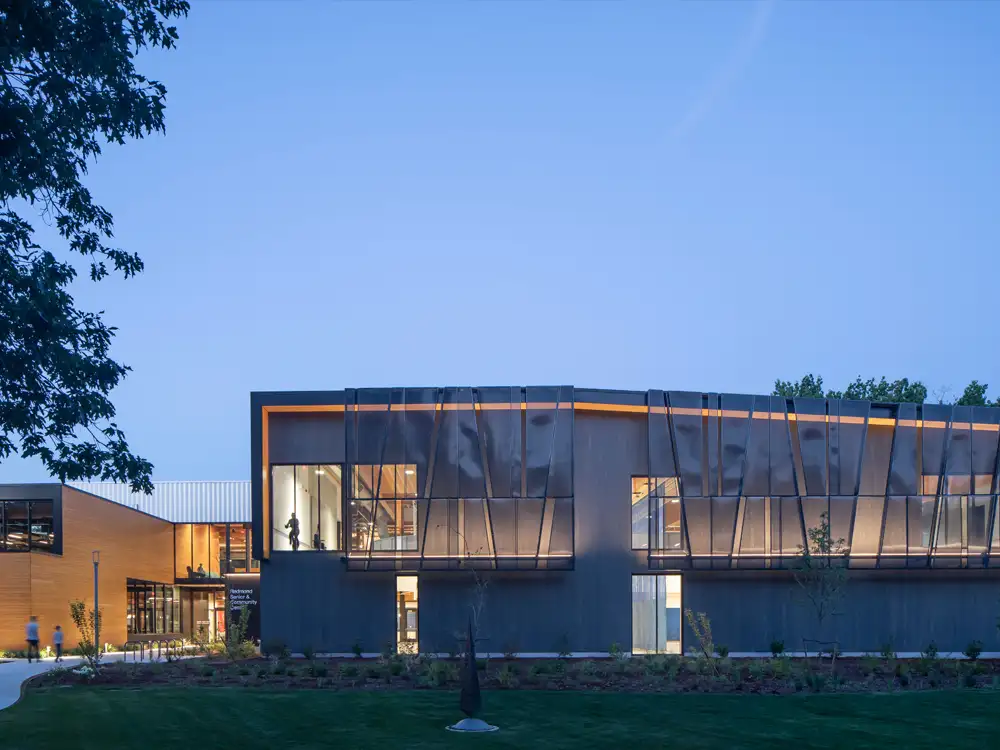
INDOOR & OUTDOOR CONNECTIONS / The strategic organization of the facility creates direct access through the building from the arrival plaza to the Sammamish River Trail, while also providing direct entry points off the senior lounge to the north and gymnasium to the south. The mass timber structure extends outward to create entry canopies and sheltered gathering space, reinforcing an indoor-outdoor relationship. The design team leveraged biophilic design principles to create a natural interior environment that leverages the warmth and character of the mass timber at all scales. The exterior is sheathed in durable hybrid wood siding, creating a harmonious balance with the wood interior and expansive window walls that offer views of the activities within and outside.
Surrounded by open lawns and public art and sculptures, the facility completes the civic campus for the city of 75,000. Outdoor terraces and plazas were strategically placed off the senior lounge, community room and gymnasium to expand program space, support community events like the City’s annual Derby Days and offer places for respite for visitors passing by along the adjacent multi-modal Sammamish River Trail.
Outdoor terraces and trail connections further extend the invitation to engage, move and gather in a landscape that feels both civic and natural.
Sustainability & Longevity
The project was designed targeting LEED Gold certification and is currently on track to achieve Platinum.
The Redmond Senior & Community Center is a space designed to serve the community and the environment. Guided by the City of Redmond’s 2020 Climate Emergency Declaration, the center prioritizes carbon reduction, environmental stewardship, and occupant well-being. Fully electric, the center uses air-sourced heat pumps and a 156 kW PV array, saving 61% in energy costs and eliminating the need for natural gas. These features offset roughly $15,000 in annual energy costs, significantly cutting carbon emissions and positioning the building to be net-zero ready.
The project pioneers the use of mass timber in a building typology traditionally dominated by steel and concrete. The center’s mass timber structure, featuring exposed glulam framing and Mass Plywood Panels (MPP), reduces embodied carbon by 24%, sequestering 977 metric tons of CO2. Notably, the center earned the first-ever LEED Innovation Credit for climate-resilient wood. In partnership with the construction team and wood advisor Sustainable Northwest, the project team fully disclosed the origins of the MPP, which were regionally sourced from Bureau of Land Management (BLM) forests near Carlton, Oregon, in the Willamette Valley. This wood comes from forests managed with the intention of improving climate resilience, enhancing biodiversity, reducing wildfire risks and storing more carbon. In addition to regional harvesting, fabrication and assembly of the timber structure occurred within 300 miles of the site. This not only supports sustainable material choices but also contributes to the long-term health of the forest ecosystem, aligning with the values of the owner and stakeholders. The warm, inviting interior creates a connection to nature, with more than 85% of interior spaces offering views of the municipal campus and Sammamish River Trail.
The team’s engagement effort with seniors, residents, and a diverse group of community members earned LEED equity credits and further aligned the project with the values of the stakeholders. A robust resiliency workshop with the City of Redmond confirmed the center’s role as a community resource, capable of providing shelter during extreme weather events and distributing supplies in emergencies. Designed for long-term adaptability, low operating costs, and emergency preparedness, the center demonstrates how civic architecture can meaningfully address climate action while strengthening community health and well-being.
The Redmond Senior & Community Center’s human-scaled design and pioneering hybrid structural system establishes a new benchmark for resilient and enduring communitycentered architecture rooted deeply in place.
Redmond Senior & Community Center, Redmond, WA
Merit Award
2025 AIA/WA Civic Design Awards
Client: City of Redmond
Firm: Johnston Architects (JA) with Opsis Architecture
Photos: ©Lara Swimmer/Esto
Gallery


- Johnston Architects PLLC
- Opsis Architecture