
Core Design Team
Firm: Signal Architecture + Research and The Miller Hull Partnership
Mark Johnson: Signal Architecture + Research – Principal Architect
Scott Wolf: Miller Hull – Partner
Claire Rennhack: Miller Hull – Associate
Alex Wolfrum: Miller Hull – Project Architect
Consultants/Collaborators
Design Collaborator/Architect of Record: The Miller Hull Partnership (AOR)
Landscape Architect: Berger Partnership
Exhibit Artist: Sans Facon
Lighting Design: Blanca Lighting
Wastewater + Systems Engineer: Jacobs in-partnership with HDR
Structural Engineer: Bright Engineering
General Contractor: Flatiron West
Public Art: 4Culture
Community Engagement: Enviroissues
Project Narrative
Building Inspiration
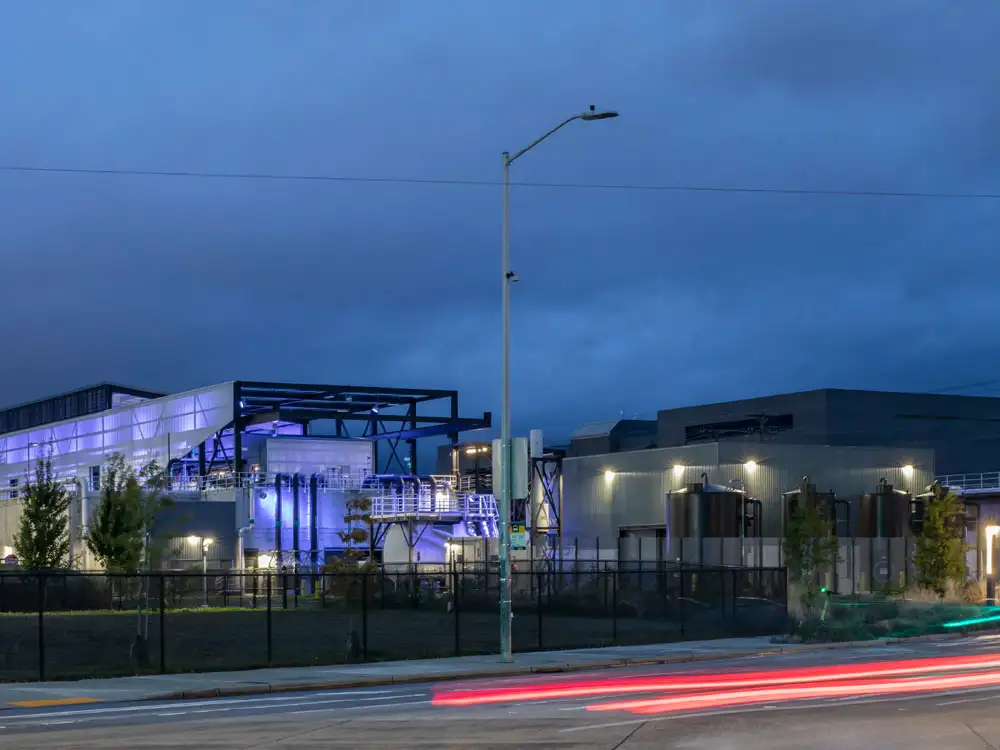
The Georgetown Wet Weather Treatment Station is a gateway to Seattle’s arts and industrial neighborhood. The campus of industrial structures leverages strategic site planning, materials, massing, and art to communicate its purpose: improving the ecological health of the Duwamish Waterway. Straightened and dredged from a 15 mile, meandering estuarine river in 1914, the Duwamish Waterway is a hardworking industrial landscape with a natural history overlay that remains visible today in the salmon, eagles, mudflats, and indigenous fishers who call it home. Rather than being off limits and hidden behind fencing, this public infrastructure embraces visibility—and the merger of public art, architecture, and landscape architecture are fundamental to its identity. The building masses, configured and illuminated to track each stage of the water treatment process renders visible what typically happens unseen. At the street edge, The Monument to Rain, a towering translucent column, will offer a poetic counterpoint: when it rains in Seattle, the column remains dry; when the skies are clear, it will rain inside the sculpture. Together, art, architecture, massing, and site animate the facility, drawing people in and celebrating the beauty and complexity of rain, water, and public service.
Building Integration
The Station occupies a highly visible site at the confluence of major arterials and pedestrian pathways. With only 3.1 acres available, the design and engineering teams employed a vertical strategy—stacking buildings and using gravity to move water through the process. This minimized the facility’s footprint while preserving view corridors and allowing the journey of water from city to river to meet engineering requirements while serving as a legible interpretation of infrastructure.
Beneath the surface, groundwater and tidal flows continue to interact across mixed layers of industrial fill and saturated soil, complicating every structural move. The Station sits in a seismic liquefaction zone, where soils can behave like liquid in an earthquake – requiring foundations to be placed with surgical precision and supported by extensive ground improvements. Buildings are aligned north–south to maximize engineering flow on the linear site, and building massing and materials respond to create a legible sequence of stormwater treatment from intake to outfall.
At street level, the design emphasizes human scale, with a material break point that introduces human scale into the industrial landscape. A 10-foot datum tops a concrete band grounding the structures with a resilient base while metal volumes above reflect the industrial operational functions. Human-scaled buildings—workshops, offices, and control rooms replace fences and walls typical to this type of facility. Rather than excluding, this facility creates visibility and invites engagement with the community.
The Operations and Maintenance Support Building anchors the most prominent corner, establishing a strong and welcoming public identity. It includes a flexible training room that can host a variety of community events. King County, in partnership with local community colleges, will lead interpretive programs for students and community members to build awareness of the facility’s purpose, promote environmental stewardship, and create workforce pathways to infrastructure operations and engineering. Within the site, the loudest, tallest, and most odor-intensive operations of wastewater are deliberately located deep in the site, with gathering, work, and education spaces at the site perimeter.
Environmental Sensitivity
Designed to serve more than 175,000 residents, the Georgetown Station is the first Envision Platinum-certified project in Washington State. It treats up to 70 million gallons of combined stormwater and wastewater during overflow events, reducing untreated discharges into the Duwamish River by up to 95%.
The Station’s approach to treatment begins with ballasted sedimentation—a process that uses fine sand and minimal coagulant to help solids settle quickly. This allows the facility to treat high volumes with limited chemical use, relying instead on the basic principles of weight and flow. Gravity does the first part of the work; ultraviolet light finishes it. This system reduces environmental impact while echoing the layered, passive logic of the estuary it replaces. The facility’s gravity-fed system limits the need for mechanical pumping, reducing both energy consumption and maintenance.
Site design incorporates green infrastructure, including bioretention planters, permeable paving, vegetated roofs, and large rainwater-harvesting cisterns—collectively supplying 50% of the site’s irrigation and providing stormwater detention. In this way, the Station’s process is both technically effective and environmentally modest—treating extraordinary volumes of water while limiting chemical use and honoring a landscape that once cleansed itself.
To reduce environmental impact during construction, more than 85% of material waste was diverted from landfills. Wood salvaged from a former onsite structure was repurposed in the interiors of the community training room, while all existing concrete was recycled offsite. Renewable energy is already in use: a 2.3kW photovoltaic system is installed on the Operations and Maintenance Support Building, and the rest of the site is solar-ready to support a future 100kW system. Restoration efforts at the outfall reintroduce mudflat and marsh habitat, reestablishing ecological functions that had been lost to urban development. These overlapping strategies express a comprehensive, layered commitment to sustainability and climate resilience.
Social Impact
The Station is the first of eight capstone projects in King County’s four-decade initiative to control combined sewer overflows still affecting parts of Seattle where storm and sewer systems were installed in the early to mid-20th century. Its designation as the first Envision Platinum project in the state underscores the Station’s positive social, economic, and environmental impact.
More than a piece of infrastructure, the Station presents a new civic model: educational, transparent, and open to the public. Interpretive features and a rooftop classroom platform allow educators to guide students and community members through the treatment process, from water’s arrival to its safe release into the river. The site is pedestrian-friendly and visually porous, with transparent operations and public-facing buildings at the edge, replacing opacity with legibility. Integrated public art further establishes the Station as a recognizable and meaningful neighborhood landmark—inviting everyday encounters with ratepayers as a system proudly at work to serve them and protect their local waters.
Client Satisfaction
King County approached the Georgetown Wet Weather Treatment Station as more than a technical necessity—it was an opportunity to change public perception of infrastructure. The design team and County worked closely together to align performance goals with a vision for a visible, community-serving, environmentally rigorous civic facility.
Placing this project in Georgetown matters. The neighborhood has long absorbed the consequences of upstream decisions—both literally and historically. By investing in public-facing infrastructure here, the County returns care to this important part of the city. An independent community-nominated Design Advisory Group, comprised of business, industrial, education, residential, and commercial neighbors was consulted over 9 work sessions throughout the design process. The result is a project that exceeds expectations: reducing environmental impact, increasing public understanding, and creating educational opportunities that will benefit future generations.
King County’s values—resilience, equity, and transparency—are made tangible in the Station’s compact footprint, welcoming public spaces, and layered design. Delivered on time and to a high standard of execution, the Station sets a precedent for infrastructure that is efficient, expressive, and deeply integrated into its community. Expected to operate approximately 20 times per year, the facility also strengthens the region’s preparedness for future weather challenges—functioning as both a safeguard and a symbol of civic care.
The Georgetown Wet Weather Treatment Station, Seattle, WA
Honor Award
2025 AIA/WA Civic Design Awards
Client: King County Wastewater Treatment Division
Firm: Signal Architecture + Research and The Miller Hull Partnership
Photos: Lara Swimmer
Gallery


- Signal Architecture + Research
- The Miller Hull Partnership