
Core Design Team
Firm: SMR Architects
Douglas Ito, FAIA – Managing Principal
Andy Phillips – Principal/Project Manager
Jacqui Aiello, LEED® AP BD+C – Designer
Consultants/Collaborators
Development Consultant: Brawner & Company / McCullough Allen
Contractor: Andersen Construction
Structural Engineer: I. L. Gross Structural Consultants
Civil Engineer: Sitewise Design
Mechanical Contractor: Auburn Mechanical
Electrical Contractor: Prime Electric & PAE Engineering
Project Narrative
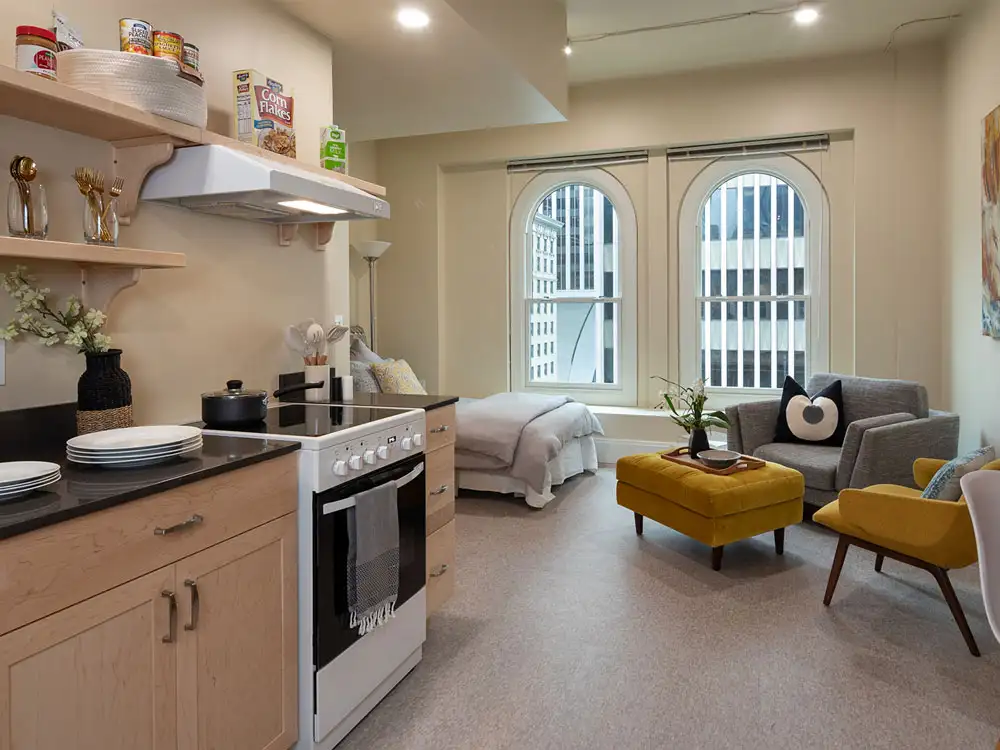
Project Summary and Context The YWCA Fifth and Seneca rehabilitation project represents a comprehensive transformation of Seattle’s first purpose-built structure for women and girls into modern permanent housing while preserving its historic significance. This ambitious undertaking converted six floors of the 1914 community center from 154 outdated SRO units into 114 well-appointed studio and one-bedroom apartments, each featuring in-unit kitchens and bathrooms that dramatically improve living conditions.
Located at 1118 Fifth Avenue in downtown Seattle, this seven-story landmark building occupies a central urban position that provides residents with direct access to essential services and transportation networks. The physical context of this project extends beyond mere rehabilitation to encompass the preservation of a nationally registered historic landmark that has served the community for over a century. Originally designed by Pacific Northwest architect E.F. Champney, who also designed the 1909 Alaska-Yukon-Pacific Expo, the building represents a significant architectural and social milestone in Seattle’s history. The structure’s enduring presence in the downtown core demonstrates the successful integration of historic preservation with contemporary housing needs.
Project Intentions and Program Requirements
The core mission driving this rehabilitation centered on addressing Seattle’s affordable housing crisis while preserving a cherished historic landmark. The project aimed to provide stable housing for low-income and formerly homeless residents, recognizing that secure housing serves as the foundation for healing, safety, and long-term stability. This initiative directly responds to the urgent need for affordable housing in Seattle’s downtown corridor, where proximity to services and transportation can significantly impact residents’ quality of life and opportunities for advancement.
The comprehensive scope included extensive mechanical, electrical, and plumbing system upgrades, complete roof replacement with solar panel installation, and critical seismic reinforcement to ensure long-term structural integrity. The first two floors underwent complete redesign to enhance the YWCA’s capacity for delivering essential direct service programs, while the upper five floors were transformed into modern residential units. This dual-purpose approach maximizes the building’s community impact by maintaining its historic role as a service provider while expanding its housing capacity.
The project’s financial structure demonstrates innovative funding coordination, drawing resources from the City of Seattle Office of Housing, low-income housing tax credits, Housing Trust Fund, federal Historic Tax Credits, and various private and public partners. This diversified funding approach, totaling approximately $80 million (total development cost), reflects the complex nature of historic preservation projects and the commitment of multiple stakeholders to addressing housing needs while preserving architectural heritage.
Design Achievement and Innovation
The rehabilitation exemplifies exceptional building inspiration through its innovative integration of modern systems within a historic framework. The design team successfully navigated the challenge of installing contemporary MEP systems while respecting the building’s historic character and avoiding interference with existing concrete structure. This required creative problem-solving to maximize space efficiency while maintaining the integrity of significant historic features throughout the interior spaces.
The project demonstrates building integration by maintaining the structure’s appropriate scale and accessibility within the downtown context. The rehabilitation preserves the building’s relationship to the surrounding urban fabric while enhancing its functionality for contemporary use. The design acknowledges the building’s historic role in the community while adapting it to serve current and future needs effectively. Environmental sensitivity manifests through multiple sustainable initiatives, including the installation of solar panels, comprehensive energy efficiency improvements, and the inherent sustainability of adaptive reuse. By preserving and rehabilitating an existing structure rather than demolishing and rebuilding, the project demonstrates serious intent to minimize environmental impact while creating modern, energy-efficient living spaces. The upgraded building systems contribute to reduced energy consumption and improved resident comfort, supporting broader goals of greenhouse gas emission reduction.
Historic Preservation Challenges and Solutions
The building’s designation on the National Register of Historic Places presented unique challenges that required careful balance between preservation requirements and contemporary housing needs. The historic significance encompassed both the original 1914 construction and subsequent 1950s alterations, requiring adherence to preservation guidelines for facade elements and interior spaces throughout the building.
The most significant challenge involved upgrading the 1950s MEP systems while remaining sensitive to historic features and avoiding interference with the existing concrete structure. The design team developed innovative solutions to route new mechanical systems through the building without compromising historic elements or structural integrity. This required detailed coordination and creative engineering to maximize space utilization while preserving the building’s character-defining features.
The preservation approach successfully differentiated between original architectural elements and new interventions, ensuring that historic fabric remained identifiable while modern systems provided necessary functionality. The rehabilitation maintained the building’s exterior character while dramatically improving interior living conditions, demonstrating that historic preservation and contemporary housing needs can coexist successfully.
Community Impact and Social Significance
The social impact of this rehabilitation extends far beyond the provision of housing units to encompass the preservation of a vital community resource and the continuation of the YWCA’s century-long mission. The project provides stable housing for over 100 women and families, directly addressing homelessness and housing insecurity in Seattle’s downtown core. This central location ensures residents have access to employment opportunities, healthcare services, and transportation networks that support their transition from surviving to thriving.
The rehabilitation supports walkability and alternative transportation by maintaining housing in a transit-accessible urban center, reducing dependence on personal vehicles and supporting sustainable transportation patterns. The building’s downtown location provides residents with human-scale neighborhood access to essential services, employment opportunities, and community resources.
The project demonstrates equitable community engagement by serving low-income and formerly homeless residents while preserving a – landmark that represents Seattle’s commitment to supporting women and girls. The YWCA’s continued presence in the building ensures that direct service programs remain available to vulnerable populations, maintaining the building’s historic mission while expanding its capacity to serve contemporary needs.
Client Collaboration and Shared Objectives
Throughout the project, collaboration between the design team and the YWCA demonstrated exceptional alignment of goals and objectives. The design team’s understanding of the client’s mission and the building’s historic significance informed every decision, ensuring that the rehabilitation would support both housing needs and service delivery requirements. The YWCA’s commitment to fair housing practices and anti-discrimination principles also guided the design approach, ensuring that all residents would have access to dignified, safe, and affordable housing.
The successful coordination of multiple funding sources reflects the client’s ability to build partnerships and advocate for resources necessary to complete this complex rehabilitation. The YWCA’s leadership in securing Historic Tax Credits, housing trust fund resources, and municipal support demonstrates their commitment to preserving the building while serving contemporary needs.
Long-term Impact and Legacy
The YWCA Fifth and Seneca rehabilitation ensures the long-term availability of 114 units of safe, affordable housing in Seattle’s downtown core while preserving a significant historic landmark for future generations. The comprehensive system upgrades and seismic reinforcement work guarantee the building’s structural integrity and operational efficiency for decades to come.
The project demonstrates that historic preservation and affordable housing development can work together to address contemporary challenges while honoring architectural heritage. The successful completion of this rehabilitation demonstrates that thoughtful design and collaborative partnership can create solutions that honor the past while building for the future, providing stable housing and essential services for those who need them most.
YWCA 5th and Seneca Rehabilitation, Seattle, WA
Honorable Mention for Historic Renovation for Affordable Housing
2025 AIA/WA Civic Design Awards
Client: YWCA Seattle|King|Snohomish
Firm: SMR Architects
Photos: William P. Wright, William Wright Photography
Gallery


- SMR Architects